
Game Audio Jobs and Skills 2026: What Employers Are Looking For

Updated: Aug 4
An analysis of 142 game-audio job postings, the roles employers are hiring for, and the skills that appear most often.
Landing a Job in Game Audio: An Updated Look at the Market
What are game companies actually looking for when they hire a sound designer, composer, music designer, dialogue specialist, or audio director? Clearly, being able to create great music and sound is essential. But job postings also tell us what employers expect beyond the work that comes out of the DAW: implementation, middleware, game engines, scripting, collaboration, documentation, production experience and, increasingly, ownership of complete audio systems.
For this report, we performed a three-month, systematic analysis of game companies, job aggregation sites and other sites including 217 individual game companies as well as major job aggregators (Soundlister, Hitmarker, LinkedIn, GameJobs.co, etc), and specialist boards (devbrada, WorkWithIndies, TealHQ, etc). We searched over a period of 3 months from April through July 2026. We discovered and analyzed 142 game audio job postings including 115 full-time employee positions, 21 contract positions, five internships (and one we couldn't quite tell!) We focused on sound-creative game-audio roles. Jobs that were primarily audio programming or computer-science positions were outside the scope of the study. We also noted job type, such as "in person" "remote" or "Hybrid"
Key Findings
Sound Designer was the largest role family, representing almost two thirds of the jobs found
Almost 40% of the postings were senior, principal, lead, director or other senior roles; the industry is looking for people with experience.
Music Composition roles -- as employees of companies-- are more common than many people think. They frequently include sound design or other skills as well.
Music Designer, a relatively recent sub-discipline, has a notable increase in job postings compared with our 2024 analysis
Wwise and "implementation" were the two most frequently listed general game audio skills, with Unreal, FMOD and Reaper also very common.
Soft skills appeared in virtually every job posting, including collaboration, cross-disciplinary work and communication
Technical Sound Designer postings all mentioned scripting with 3/5 also mentioning C++, though with C++ more often as a 'nice to have' than a hard requirement
6% of postings were for internships or other entry level roles. The majority of entry-level roles and internships were outside the US.
Posted salaries ranged from $43,200 to $353,000, with the median range midpoint of $145,000, but as expected, vary greatly by role and level.
Important note on Salary information in this report.
Almost 20% of the job postings we found contained salary ranges, which we include in this report. It should be noted that the majority of these postings are from jobs listed in California or Washington State, which have laws that require job postings to provide accurate salary information. These represent game audio jobs in three of the most expensive regions to work and live in the US: Los Angeles, San Francisco, and Seattle, as well as their surrounding suburbs. For this reason, although accurate for those regions, salaries listed here should not necessarily be used as a broad salary guideline for other states or countries. The 2025 Game Audio Industry Survey is likely a better indication of salaries as a whole.
Overview of the Job Postings type.
Job Postings Found | 142 |
Full-time (FTE) positions | 116 (81.7%) |
Contract / Fixed-term | 21 (14.8%) |
Internship | 5 (3.5%) |
US-based postings | 45 (31.7%) |
US postings with salary disclosed | 27 (60% of US postings) |
Countries represented | 26 |
Studios / Employers represented | ~90 |
Date range | April 21 – July 14, 2026 |
Despite ongoing industry consolidation and the layoffs that continue into 2026, the game audio job market remains active. The 142 eligible postings collected over approximately three months represent a robust set of opportunities. We should note that this job list likely skews toward larger studios and aggregated boards that may undercount smaller indie and mobile employers. In addition, although some jobs are listed as 'contract', many jobs filled by freelancers never have job postings, and therefore are not represented in this study.
Studio Type Distribution
AAA studios dominate the jobs we found, accounting for just over four in ten of postings. Studios represented include Nintendo (Retro Studios), Blizzard, Treyarch, Activision Sledgehammer, Riot Games, CD Projekt Red, Electronic Arts (multiple labels), Hoyoverse, Ubisoft, Sony Interactive Entertainment / PlayStation Studios, Netflix, and Valve. Independent and mid-sized studios (19%) include the likes of Mob Entertainment , Larian Studios, Cloud Imperium Games, and People Can Fly. The Audio Outsourcing/Services category includes studios like SIDE, Vicious Sound, and Arrival.

Studio Type | Count | % of Dataset |
|---|---|---|
AAA / Major Studio | 59 | 41.5% |
Independent / Mid-sized Studio | 39 | 27.7% |
Mobile | 13 | 9.2% |
Casino / Arcade | 13 | 9.2% |
Audio Outsourcing / Services | 10 | 7.1% |
XR/VR | 2 | 1.4% |
Other | 6 | 4.3% |
The Casino/Arcade segment is a notable presence; slot and iGaming studios (Evolution/Red Tiger, Konami, IGT, PlayTech, OnlyPlay) consistently hire sound designers with distinct requirements — an area often overlooked in traditional game audio career discussions. These studios value fast turnaround on high volumes of sound and music and are less likely to require shipped AAA titles as a prerequisite, making them a viable entry point for practitioners building their professional track record.
Work Arrangement Trends

Work Arrangement | Count | Percentage |
On-site (required) | 97 | 68.3% |
Flexible / Negotiable | 13 | 9.2% |
Remote | 11 | 7.7% |
Hybrid | 8 | 6.3% |
Unspecified | 11 | 7.7% |
On-site work remains the global norm, with nearly 70% of postings requiring physical presence. This is particularly true in Asia (Japan, China, Indonesia, Vietnam) and at many European studios where in-studio collaboration is treated as non-negotiable. That said, the picture shifts meaningfully when looking at specific segments: audio outsourcing and services firms (SIDE, Vicious Sound, Onlyplay, Crater Studios) are more likely to advertise remote or flexible arrangements, as are mobile and platform-agnostic roles.
Among US-based postings, hybrid and flexible arrangements are more common — companies like Meta, Blizzard, Netflix, and Roblox have all advertised positions with hybrid or location-flexible language.
Game Audio Job Openings by Level

Level | Postings | Percentage |
Senior or Higher | 56 | 39.4% |
Mid-level/general | 77 | 54.2% |
Entry-level/internship | 9 | 6.3% |
We found relatively few entry-level jobs, all of which except one were outside the US. The current 2026 job market skews heavily towards mid-level or senior positions.
Game Audio Job Titles
Because of the wide variety of job titles across different companies that represent the same work -- for example "Audio Artist" and "Sound Designer" -- we 'normalized' all the job postings to a single set of job titles. See the Appendix if you are interested how we mapped posted job titles to the standard lexicon we use in this report.

The most common job postings by far are for Sound Designers of all levels, representing more than seven in ten game audio jobs.
Game Audio Role-Specific Skills and Requirements
The following section lists the various game audio roles and correlated with the skills and requirements we gathered from the game audio job postings. We counted a skill as present in a job listing without regard to where in the job posting we found it. So, for example, we counted "FMOD" as a skill whether it was listed in a 'requirements" section, a "nice to have" section or anywhere in the main body of the job posting. 38% of the job postings did not list any middleware in the job posting.
Of the 88 job postings that mentioned Wwise or FMOD, 36 (41%) said that Wwise was specifically required, while 5 (6%) said FMOD was specifically required. A majority use phrases like "....such as FMOD or Wwise." This indicates that precise knowledge of a particular tool is often less important than understanding the concepts and being able to apply them with whatever tool the studio uses.
Game Sound Designer
Sound Designer remains the most commonly posted title at nearly a third of all postings. This is consistent with previous GSC analyses. The role is broad: it encompasses entry-level asset creation positions at mobile studios, mid-level implementation-heavy roles at AAA developers, and even full-cycle sole-audio-practitioner roles at smaller indie teams. The core expectation across all levels is the ability to create high-quality, distinctive sounds and implement them into a game engine or middleware pipeline. At the entry end, Sound Designer postings tend to emphasize portfolio strength and a shipped or near-shipped personal project; at the mid-career end, they increasingly emphasize implementation depth, scripting capability, and engine proficiency alongside craft.
Skills Breakdown: Game Sound Designer
Skill / Tool mentioned in posting | % of Sound Designer Postings |
|---|---|
Wwise | 59% |
Implementation required | 59% |
Reaper | 43% |
Unreal Engine | 42% |
Pro Tools | 37% |
FMOD | 35% |
Scripting | 33% |
Recording | 30% |
Music Composition (bonus) | 27% |
Unity | 24% |
Formal Education | 22% |
Blueprints | 14% |
Excerpts from Game Sound Designer Skill Requirements Job Postings
“Design and implement high-quality in-game sound effects.” — Multiple studios
“Proficient using audio development tools (e.g. Wwise / FMOD / Unreal / Unity).” — Paraphrased Standard language across the multiple postings
“Proficiency implementing audio across levels, animation, cinematics, scripted sequences, Blueprints, data tables, ambient actors, volumes, triggers, and related systems.” — People Can Fly
“Shipped-game experience and ownership of an audio pipeline from pre-production through release.” — CurlyBlue
“Design, create, implement, and manage large volumes of audio.” — People Can Fly
“3+ years of professional game audio experience, with at least one shipped title using Wwise and a commercial game engine.” — 2K / Gearbox Studio Quebec
Game Sound Designer Salaries
Tier | Salary Range (USD) | Avg Midpoint |
Sound Designer (Mid) | $60,000 – $195,000 | ~$114,000 |
The wide range reflects the breadth of the title — a Sound Designer at a mobile startup and at Meta (which posted a UI/UX Sound Designer at $166,000–$195,000) carry the same title but vastly different compensation.
Most Sound Designer postings require 2-5 years of professional experience, with an average of 3-4 years. A 'shipped title' is frequently cited as more important than a specific year count, with many wanting evidence of 'full pipeline' ownership.
Senior Game Sound Designer
15% were of the jobs found were for a Senior Sound Designer. The responsibilities remain hands-on, but the language shifts toward ownership, expertise, quality standards, complex systems and the ability to work with less supervision.
Senior sound designer job postings were more likely than general sound designers to mention implementation, Wwise, Unreal and troubleshooting. They were also more likely to ask for a shipped title, a portfolio that demonstrates context and decision-making, and some form of mentoring or creative feedback.
Several postings in our list reflect the “specialist within a generalist frame” model at AAA studios. EA DICE sought a Senior Sound Designer with a music background — someone who could “contribute across a broad range of sound design challenges while also working with music implementation.” Behaviour Interactive sought a Senior Sound Designer specifically for Dead by Daylight. Vicious Sound emphasized “at least three years in AAA game audio” as a distinct requirement beyond general professional experience.
Excerpts from Senior Game Sound Designer Skill Requirements Job Postings
“Be a creative and technical expert who can elevate the auditory experience of our projects.” — Vicious Sound
“Experience sourcing, creating, implementing, and refining high-quality audio content for games or interactive entertainment.” — EA DICE
“Minimum 5 years of sound-design experience, including at least three years in AAA game audio.” — Vicious Sound
“Proficiency with tools such as Pro Tools, Reaper, Soundminer, Wwise, FMOD, Unreal Engine, and Unity.” — Vicious Sound
“The Senior Sound Designer blends artistic sensibility with a strong technical grasp of tools and techniques.” — Behaviour Interactive
“Proficient with common studio hardware, editing techniques and software such as Reaper, Sound Forge, Waves, FabFilter and iZotope RX.” - EA DICE
"Perform Foley and field recording to support sound design needs." -2K / Gearbox, Senior Sound Designer
"Help define what narrative audio means for our project and mentor the next generation of storytellers on our team." - HoYoverse, Senior Sound Designer
Senior Game Sound Designer Salaries
Tier | Avg Low | Avg High | Avg Midpoint |
Senior Sound Designer | $108,970 | $170,430 | ~$139,700 |
Virtually all Senior Sound Designer posting requires 5-7 years of experience, though candidates with fewer years, but a strong, shipped AAA credit and demonstratable implementation experience are often competitive.
Lead Game Sound Designer
11% of job postings were mapped to Lead Sound Designer or Audio Lead. The distinction between senior and lead is not always clean, but lead roles were much more likely to describe people, schedules, vendors, creative direction and project-wide consistency.
Put another way, this is often a player-coach role. The person still designs and implements sound, but is also responsible for reviews, mentoring, resource planning and making sure the entire audio team is moving toward the same target.
Excerpts from Lead Game Sound Designer Skill Requirements from Postings
"Work with the Audio Director to define and maintain vision in your project." - Cloud Imperium
“Ability to be an expert individual contributor on some days and a manager of internal team members and external vendors on other days.” — Paraphrased Lead language across multiple postings
"Collaborate with audio leadership on project sound design pillars, tone, mix direction, standards, and technical goals"
Take on high level of complexity in sound design work including weapons, character audio, and more - Gearbox Studio
“ Plan, source, and supervise external audio partners, composers, voice talent, and vendors as needed..” — Skydance
“Own and communicate a clear audio vision that delivers player value and aligns with project and franchise goals.” — Sega / Audio Director framing overlapping with Lead language
“Collaborate closely with project Directors, Leads, Producers, and cross-discipline teams (Music, VO, Programmers) to craft immersive, high-quality, and technologically advanced audio experiences.” — CD Projekt Red
Lead Game Sound Designer Salaries
Tier | Average Low | Average High | Average Midpoint |
Lead Sound Designer | $154,600 | $197,300 | $176,100 |
The Lead Sound Designer role lists 5-10 years of experience, averaging just over 6. many postings also reference direct prior experience managing or mentoring.
Technical Game Sound Designer
4% of job postings were for Technical Sound Designer
The job straddles sound design and engineering: practitioners are expected to build systems, write scripts, implement interactivity, maintain audio pipelines, and increasingly to collaborate directly with engine teams. For practitioners with both audio craft and some programming skills, this is one of the most in-demand and compensated paths in game audio.
Excerpts from Technical Game Sound Designer Skill Requirements Job Postings
“Integrate music and sound effects into the game using interactive techniques and principles.” — Standard TSD language
“Collaborate under the guidance of a Lead to develop sounds for environments, game modes, destruction, and animations..” — EA/DICE
“Execute and maintain the entire audio pipeline, from asset production through implementation, integration, and deployment.” — Larian Studios
“Proficient with Python and C++ programming languages.” — Larian Studios
“Implement and own in-game audio using Unreal Engine’s built-in audio stack. Design and maintain interactive audio systems (adaptive music, environmental audio, tension systems, etc.)” — Mob Entertainment
“You will work in the middleware (Wwise) and in the proprietary engine through scripting or the editor’s graph system.” — Ubisoft
“Troubleshoot audio issues and bugs.” — Universal TSD requirement
Technical sound designers often listed specific skills in their job postings, though as noted previously, particular skills sometimes showed up in the "nice to have" rather than the "requirements" section of the job listing.
Skill | TSD (All Tiers) |
Implementation | 100% |
Wwise | 90%+ |
Scripting / Programming | 80%+ |
Unreal Engine | 75%+ |
Blueprints | 60%+ |
C++ / Python (Senior TSD) | 50%+ |
Technical Sound Designer Salaries
Tier | Avg Low | Avg High | Avg Midpoint |
Technical Sound Designer | $65,893 | $99,360 | ~$82,627 |
Senior Technical Game Sound Designer
5% of job postings were for Senior Technical Sound Designer
The Senior Technical Sound Designer adds architecture standards and mentorship to the technical implementation work. Wwise appeared in 86% of the postings and scripting in 71%. Unlike the general Technical Sound Designer sample, the senior group often emphasized tools, documentation, scalable workflows and coordination with engineering rather than a specific low-level language.
Excerpts from Senior Technical Sound Designer Skill Requirements Job Postings
"Required familiarity of scripting/coding languages, preferably Python or Lua." - Treyarch, Senior Technical Sound Designer
"Help design and improve audio workflows, pipelines, and tools." - Prophecy Games, Senior Technical Sound Designer
"Test and debug all in-game dialog for multiple implementation pipelines." -Activision Sledgehammer, Senior Technical Dialogue Designer
Senior Technical Sound Designer Salaries
Tier | Avg Low | Avg High | Avg Midpoint |
Senior Technical Sound Designer | $101,600 | $147,933 | ~$124,767 |
Principal Game Sound Designer
Principal Sound Designer postings (4 that we found) represent the most senior sound design role that does not carry formal management responsibility. Postings at this level tend to emphasize “expert-level” mastery of implementation tools, leadership without direct reports, and significant prior AAA experience.
Blizzard listed 13 years of experience as their specification for a Principal posting — a figure that underscores how elite this tier is. CD Projekt Red used the “Expert Sound Designer” title, which signals the same career tier as Principal at other studios. At this level, postings rarely enumerate basic tool expectations because it is understood that a practitioner with 10–15 years of shipped AAA experience is proficient in whatever the studio uses.
Excerpts from Principal Game Sound Designer Skill Requirements Job Postings
"Anticipate project needs and independently design and implement solutions without supervision." Blizzard, Principal Sound Designer
"Collaborate with audio programmers and sound designers to design, implement, and scale audio pipelines." Blizzard, Principal Sound Designer
"Mentor Sound Designers to support their growth and effectiveness." CD Projekt Red, Expert Sound Designer
How much does a Principal Game Sound Designer Make?
Tier | Avg Low | Avg High | Avg Midpoint |
Principal Sound Designer | $128,400 | $188,400 | ~$158,400 |
Audio Director
Audio Director postings , (5.6%) represent the highest-profile and highest-compensated category — and the roles vary significantly by studio size and context. At a large AAA studio, the Audio Director may manage dozens of staff and vendors across a global project. At an indie like Mob Entertainment (Poppy Playtime), the Audio Director is a “startup” leader building the function from scratch — requiring creative vision, production management, and hands-on implementation capability simultaneously. Both versions demand the same fundamental ability: to hold a coherent audio vision across the entirety of a complex, multi-year project while managing the people and resources needed to execute it.
Sony Interactive Entertainment’s posting for a Senior Director, Sound Design offers a good picture of what game audio leadership looks like at the highest level: 15+ years of audio leadership experience, minimum 6 shipped AAA titles in a senior role, and a salary of $235,400–$353,000. Mob Entertainment reflects the indie end of the spectrum: 10+ years required, horror-genre expertise valued, and salary ranging from $139,000–$224,000 depending on US location. The range of contexts in which an Audio Director can operate is wide, and so is the compensation range.
Excerpts from Audio Director Skill Requirements Job Postings
“Key responsibilities include creative leadership for game audio, music production and sound design; creative direction and oversight across client engagements” — SIDE
“Direct the creation and implementation of all project audio, working with audio specialists and stakeholders to drive efficient production, high quality, and performant content.” — Sega
“The ideal candidate understands how sound shapes fear, tension, pacing, and psychological storytelling in interactive media.” — Mob Entertainment
“Partner directly with executive and senior leadership to align sound strategy with overall PlayStation Studios goals.” — Sony Interactive Entertainment
“15+ years of audio leadership experience within AAA game development. Minimum of 6 shipped AAA games in a senior sound leadership role.” — Sony Interactive Entertainment
Audio Director roles require 8-15 years of experience. AAA credits in a senior leadership capacity are almost universally expected, although the Sony posting of "6 shipped AAA games" is a bit of an outlier.
Game Audio Director Salaries
Four of the eight job postings for Audio Director listed salary ranges, which are shown individually below:
Studio | Role | Salary Range |
Sony / PlayStation Studios | Sr. Director, Sound Design | $235,400 – $353,000 |
Netflix | Audio Lead (Director-equivalent) | $200,000 – $280,000 |
Mob Entertainment | Audio Director | $139,000 – $224,000 |
Team LFG / PlayStation | Audio Director | $157,000 – $236,000 |
Average | Audio Director | ~$190,400 – $284,800 |
Music Designer
2.8% pf the job postings were classified as Music Designer, a relatively recent role in game audio. A music designer defines how music behaves interactively: states, transitions, layers, rules, implementation, runtime performance and the relationship between gameplay and musical structure. Specifically, it is not a composer job with a different name.
All four music-design postings mentioned Wwise. Half mentioned Unreal, FMOD, Reaper, Pro Tools, source control and music composition. External composers and vendors appeared in every posting in the text scan, showing that the role often combines system design with music supervision.
Excerpts from Game Music Designer Job Postings
"Partner with game teams to define and support interactive music system behavior, including transitions, layering, states, and real-time logic." Riot Games, Interactive Music Design Manager
"Guide and support external composers and vendors on interactive music design best practices for real-time gameplay." Riot Games
"Participate in long-term music-brand development." - Kuro Games, Senior Music Designer
Skills listed for Music Designer
Skill | Percentage |
Wwise | 100% |
Unreal | 50% |
Reaper | 50% |
FMOD | 50% |
ProTools | 50% |
Music Composition | 50% |
Only a single salary range was posted, $135,700 - $188,700. Experience required was listed as 5 years for each posting.
Game Composer & Composer/Sound Designer
Although many companies hire independent, freelance composers to write music for their games, many companies still have 'in-house' composers; full-time employee staff composers. This is especially true in smaller game companies, or casino/slot machine companies.
11 postings (7.7%) were grouped as Composer or Composer/Sound Designer. Some were dedicated music roles, while others - especially at smaller studios, mobile developers and physical gaming companies - expected one person to compose music, create sound effects, record voice or instruments and deliver production-ready assets. 37% of jobs with "composer" in the title were also expected to create sound effects. Implementation, Wwise, FMOD, Unity, recording and DAW skills also appeared in the same percentage of postings. An in-house game composer may be expected to understand the entire audio pipeline, not only write cues.
Excerpts from Game Music Composer & Composer/Sound Designer Job Postings
"Ability to compose, arrange, and mix music in a wide variety of styles and genres." Light & Wonder, Composer/Sound Designer
"Incredibly comfortable writing music and designing sound effects for any given style on a tight deadline." Valicy Games, Composer/Sound Designer
"By around 6 months, you are expected to work on your own as a Music Composer within the team." Gameloft, Music Composer
Only one "Composer" job posting listed salary, which was in the range of $60,000 - $80,000. Experience typically listed 2-3 years required. One additional contract composer listed a rate of EUR 300-500 ($342 - $570) per minute.
Game Dialogue Designer
8 postings (5.6%) were grouped into dialogue and voice work. The titles included Voice Designer, Senior VO Designer, Dialogue Designer, Dialogue Editor and Lead Voice Design. Typical roles included casting or performance concerns, recording, editing, metadata, localization, asset tracking, runtime processing, implementation, dynamic mixing and QA. Recording and implementation each appeared in 75% of the job postings, while Wwise, Reaper and Pro Tools each appeared in half.
None of the Dialogue jobs posted we found included salary ranges
Excerpts from Game Dialogue Job Postings
“Execute the technical and creative Audio Vision for Voice, under the supervision of the Voice Lead. Design, test, and implement systemic Wwise VO systems.” — Larian Studios
“Direct voice actors, guiding intention, emotion, and performance with clarity and respect.” — Ubisoft Montreal
“Scripting knowledge (Lua or Python)” listed as a nice-to-have for Voice Designers. — Larian Studios
Entry-level Game Audio Jobs and Internships
We found three entry level job postings, and 6 internships, the majority (89%) of which are based outside the US. These positions were relatively rare, which is consistent with the industry practice of hiring many people after they have already developed a strong portfolio or some production experience.
The entry-level postings were not technologically "light." Unreal appeared in 78%, and Wwise, implementation and formal education each appeared in 67%. Several expected a portfolio, some implementation knowledge, and the ability to work in a professional pipeline even when the position was explicitly framed as a learning opportunity.
Skill | Percentage |
Unreal | 78% |
Wwise | 67% |
Implementation | 67% |
Formal Education | 67% |
Reaper | 56% |
ProTools | 56% |
Excerpts from Entry-level/Internship Job Postings
"Create and implement audio systems via Audiokinetic Wwise and Unreal Engine 5." Escape Velocity, Associate Technical Audio Designer
"A portfolio or demo reel is strongly encouraged." Gameloft Vietnam, Sound Designer Intern
"Create, implement, and maintain audio assets for characters, objects, and environments." Behaviour Interactive, Sound Designer Intern
“Basic knowledge of Reaper, Pro Tools, Audition, Audacity, or a similar DAW. Unity, Unreal, FMOD, Wwise, or scripting knowledge is a plus. A portfolio or demo reel is strongly encouraged.” — Gameloft Vietnam
General Game Audio Skills and Software
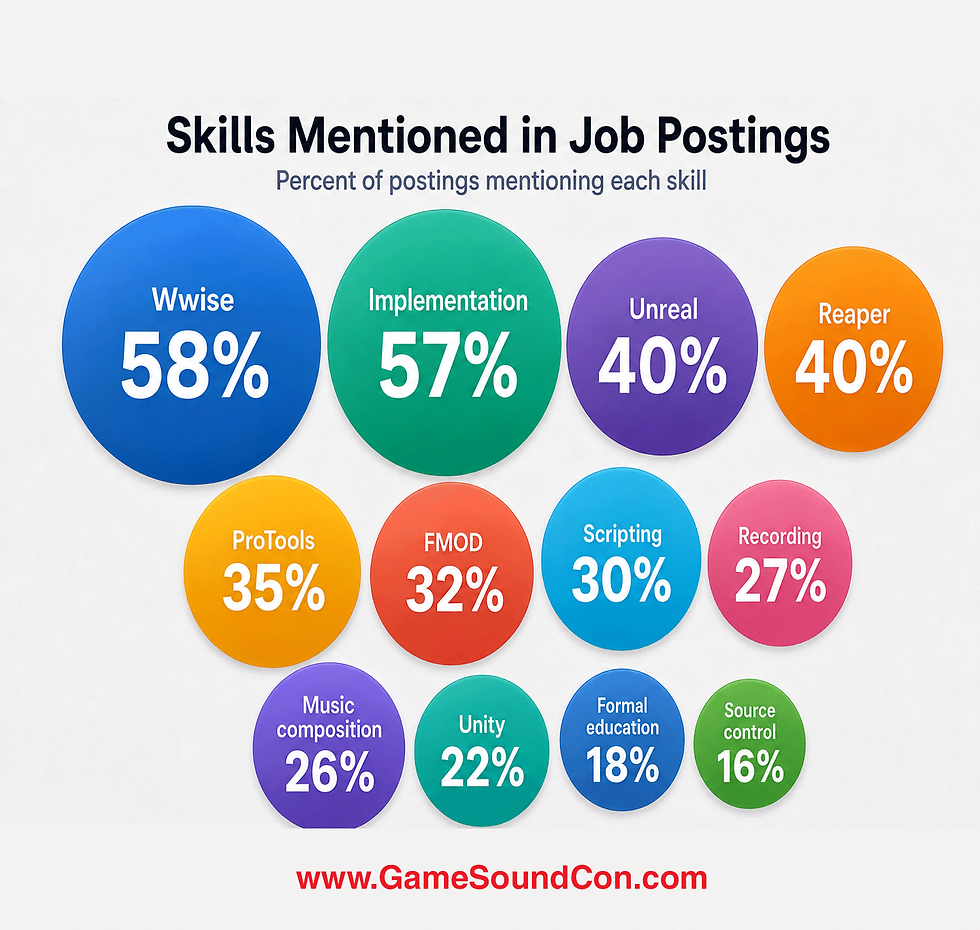
Below are the most frequently listed skills and software terms across all 142 eligible job postings. We counted a term whether the posting described it as required, preferred, desirable or a bonus. We did not count basic creative ability such as "can design sound" or "can compose music," since those skills are assumed across just about all job postings.
Wwise (58%)
Wwise was the most frequently named game-audio middleware. It appeared across sound design, technical, music, dialogue and leadership roles. The percentage is lower than in the 2024 posting study, but the this year's study is broader in geography and job type, so the figures are not directly comparable.
Implementation (57%)
Implementation was highly correlated with Wwise. This is one of the clearest findings in the dataset: employers expect audio people to get content into the game, not simply deliver files to someone else.
Unreal (40%)
Unreal appeared in four in ten postings. Depending on the role, that may mean basic editor navigation, integrating audio middleware, working with animation events, using Blueprints or MetaSounds, profiling, or collaborating with engineers on engine systems.
Reaper (40%)
Reaper was the most frequently listed DAW. Its popularity in game audio is helped by its flexibility and scripting, but most job descriptions still framed DAW knowledge as fluency in one or more professional tools rather than loyalty to one application.
ProTools (35%)
ProTools remained common, particularly in dialogue, recording, cinematic, post-production and large-studio workflows. Half of the dialogue/voice postings mentioned it.
FMOD (32%)
FMOD appeared in almost one-third of the postings. As with Wwise, employers often listed it as one acceptable middleware environment rather than an exclusive requirement.
Scripting (30%)
Scripting ranged from Blueprints and graph-based logic to Python, Lua, C# and C/C++. It was universal in the small Technical Sound Designer sample, but also appeared in general sound-design roles as a workflow and automation skill.
Recording (27%)
Recording included field recording, Foley, voice-over, performance capture, instrument recording and studio operation. It was particularly important in dialogue/voice and composer/sound-designer roles.
Music composition (26%)
Composition appeared in more than one-quarter of all postings, even though only 11 postings were classified primarily as composer or composer/sound-designer roles. Music literacy remains useful across broader audio jobs.
Unity (22%)
Unity appeared less often than Unreal, which may partly reflect the sample bias toward larger studios and publicly posted roles. It remained important in mobile, indie, VR and smaller-team contexts.
Formal education (18%)
Fewer than one in five postings explicitly coded a degree or formal education. As the 2025 survey comparison below shows, however, a degree can be uncommon as a stated requirement while still being common among the people who are actually hired.
Source control (16%)
Source control appeared in 16% of postings, and is a sign that game audio is part of a shared software-development pipeline. Perforce was the most common named example.
Virtually every posting assumes that the applicant can create professional-quality audio. Employers rarely explain at length that a sound designer needs to edit, process and mix sound, or that a composer needs to write and produce music.
What separates the postings is how often they also expect the audio person to work inside the game. Implementation appeared in 57% of the coded records. Wwise appeared in 58%, Unreal in 40%, FMOD in 32%, and scripting in 30%. The modern game-audio job is generally not "make sounds and hand them off." It is more likely to include integrating the content, testing it in context, revising it, documenting the work, and solving problems with designers and engineers.
Game Audio Soft Skills
Virtually every job listing described soft skills they expect any job applicant to have. They represent skills required to work effectively and productively on large and small teams
Collaboration / cross-discipline | 109/142 | 77% |
Communication | 87/142 | 61% |
Passion for games/audio | 53/142 | 37% |
Project planning / scheduling | 47/142 | 33% |
Problem solving / troubleshooting | 46/142 | 32% |
Mentoring / team leadership | 41/142 | 29% |
Portfolio / demo reel | 39/142 | 27% |
Shipped title / production experience | 38/142 | 27% |
Vendor / outsourcing | 38/142 | 27% |
Documentation | 37/142 | 26% |
Appendix A: Game Audio Job Title Translation
The following table maps original job titles as posted by employers to the revised names used in this report. This translation enables comparison across postings that describe similar responsibilities under different titles.
Normalized Job Title | Job Titles in Job Postings | % |
Sound Designer | Sound Designer, Audio Designer, Audio Artist, SFX Artist, UI/UX Sound Designer, Soundscape Designer | 32% |
Senior Sound Designer | Lead Audio Designer, Senior Audio Designer, Senior Audio Artist | 15% |
Lead Sound Designer | Lead Audio Designer, Audio Lead, Lead Sound Designer, Manager: Sound Design | 11% |
Composer or "Composer/Sound Designer" | Music Composer, Composer, or Composer/Sound Designer | 8% |
Intern/Entry-level | Sound Design Intern, Assistant Audio Artist, Associate Technical Audio Designer, Intern | 6% |
Audio Director | Audio Director, Project Audio Director, Senior Manager Audio Direction, Sr. Director Sound Design Head of Audio Production | 6% |
Dialogue/Voice | Voice Designer, Senior VO Designer, Dialogue Designer, Dialogue Editor, Lead Voice Design | 6% |
Senior Technical Sound Designer | Senior Technical Sound Designer, Senior Technical Audio Designer | 5% |
Technical Sound Designer | Technical Audio Artist, Technical Audio Designer, Technical Sound Designer | 4% |
Principal Sound Designer | Principal Sound Designer, Expert Sound Designer, Senior/Principal Audio Designer | 3% |
Music Designer | Interactive Music Designer, Senior Music Designer, Interactives Music Design Manager | 3% |
Audio Projection/Project Management | Audio Producer, Audio Project Manager, | 2% |
Appendix B: Data Notes
Salary scope: Salary analysis is restricted to US-based postings with disclosed compensation ranges. Non-US salaries, where disclosed in local currency, are excluded from calculations to avoid purchasing-power and currency conversion distortions. As noted above, US salaries are almost all from California and Washington State, each of which have laws requiring salary ranges to be listed on job postings.
Studio type classification: Studios are classified by their primary business activity at the time of posting.
Contract and internship roles: Contract and internship roles are included in skill frequency analysis (Section 5) and role-type analysis (Section 4) but excluded from the core salary analysis. Where contract or internship compensation was disclosed, it is noted in the role-specific sections only.
Skill analysis: Skills (Wwise, FMOD, Reaper, etc) are looked at as binary variables (present / not present) per posting based on explicit language in the job description. A skill recorded as “present” may appear as a requirement, a preferred qualification, a “nice to have, ” or in other parts of the posting. Frequency figures therefore represent the proportion of postings in which a skill appears at any requirement level — not exclusively hard requirements. Where the analysis distinguishes between required and preferred, this is noted in the text.
This report is produced for educational and career development purposes. Salary data is sourced from publicly disclosed employer postings and is presented as-is. GameSoundCon makes no representations regarding the accuracy of employer-disclosed figures. All job posting quotations are presented verbatim as sourced from official employer career pages and ATS platforms.


